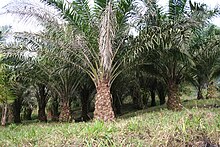
Elaeis guineensis is a species of palm commonly called African oil palm or macaw-fat. It is the principal source of palm oil. It is native to west and southwest Africa, specifically the area between Angola and the Gambia; the species name guineensis refers to the name for the area, Guinea, and not the modern country which now bears that name. The species is also now naturalised in Madagascar, Sri Lanka, Malaysia, Sumatra, Central America, the West Indies and several islands in the Indian and Pacific Oceans. The closely related American oil palm Elaeis oleifera and a more distantly related palm, Attalea maripa, are also used to produce palm oil.
Human use of oil palms may date as far back as 5,000 years in West
Africa; in the late 1800s, archaeologists discovered palm oil in a tomb
at Abydos dating back to 3,000 BCE.[It is thought that Arab traders brought the oil palm to Egypt.
Description
Mature palms are single-stemmed and grow to 20 m tall. The leaves are pinnate and reach between 3-5 m long. A young palm produces about 30 leaves a year. Established palms over 10 years produce about 20 leaves a year. The flowers are produced in dense clusters; each individual flower is small, with three sepals and three petals.
The palm fruit takes five to six months to mature from pollination to
maturity. It is reddish, about the size of a large plum, and grows in
large bunches. Each fruit is made up of an oily, fleshy outer layer (the
pericarp), with a single seed (the palm kernel), also rich in oil. When ripe, each bunch of fruit weighs 40–50 kg (88–110 lb).
Planting

Oil palm fruit
For each hectare of oil palm, which is harvested year-round, the annual production averages 10 tonnes[citation needed] of fruit yielding 4,000 kg of palm oil and 750 kg[citation needed] of seed kernels yielding 500 kg of high quality palm kernel oil, as well as 600 kg of kernel meal. Palm fronds and kernel meal are processed for use as livestock feed.
All modern, commercial planting material consists of tenera palms or
DxP hybrids, which are obtained by crossing thickshelled dura with
shell-less pisifera. Although common commercial germinated seed is as
thick-shelled as the dura mother palm, the resulting palm will produce
thin-shelled tenera fruit. An alternative to germinated seed, once
constraints to mass production are overcome, are tissue-cultured or
"clonal" palms, which provide "true copies" of high-yielding DxP palms.
An oil palm nursery must have an uninterrupted supply of clean water
and topsoil which is both well-structured and sufficiently deep to
accommodate three rounds of on-site bag-filling. Approximately 35 ha can
grow enough seedlings over a three-year period to plant a 5,000-ha
plantation. Prenursery seedlings must be watered daily. Whenever
rainfall is less than 10 mm per day, irrigation is required, and the
system must be capable of uniformly applying 6.5 mm water per day.
Prenursery seedlings in the four-leaf stage of development (10 to 14
weeks after planting) are usually transplanted to the main nursery after
their gradual adjustment to full sunlight and a rigid selection
process. During culling, seedlings that have grassy, crinkled, twisted,
or rolled leaves are discarded.
Weeds growing in the polybags
must be carefully pulled out. Herbicides should not be used. Numerous
insects (ants, armyworms, bagworms, aphids, thrips, mites, grasshoppers,
and mealybugs) and vertebrates (rats, squirrels, porcupines, wild boar,
and monkeys) are pests in oil palm nurseries and must be carefully
identified before control measures are implemented.
After eight months in the nursery, normal healthy plants should be
0.8–1 m in height and display five to eight functional leaves.
The proper approach to oil palm development begins with the
establishment of leguminous cover plants, immediately following land
clearing. They help prevent soil erosion and surface run-off, improve
soil structure and palm root development, increase the response to
mineral fertilizer in later years, and reduce the danger of
micronutrient deficiencies. Leguminous cover plants also help prevent
outbreaks of Oryctes beetles, which nest in exposed decomposing
vegetation. Both phosphorus and potassium fertilizers are needed to
maximize the leguminous cover plants' symbiotic nitrogen-fixation
potential of approximately 200 kg nitrogen/ha/yr, and are applied to
most soils at 115 to 300 kg phosphorus oxide/ha and 35 to 60 kg
potassium oxide/ha. Young palms are severely set back where grasses are
allowed to dominate the inter-row vegetation, particularly on poor soils
where the correction of nutrient deficiencies is difficult and costly.
Crop nutrient

Oil palm Elaeis guinnensis
Nutrient uptake
is low during the first year but increases steeply between year one and
year three (when harvesting commences) and stabilizes around years five
to six. Early applications of fertilizer,
better planting material, and more rigid culling have led to a dramatic
increase in early yields in the third to sixth years from time of
planting. In regions without a significant drop in rainfall, yields of over 25 tonnes of fresh fruit bunches per hectare have been achieved in the second year of harvesting.
Nitrogen deficiency is usually associated with conditions of water-logging, heavy weed infestation, and topsoil erosion.
Symptoms are a general paling and stiffening of the pinnae, which lose
their glossy lustre. Extended deficiency will reduce the number of
effective fruit bunches produced, as well as the bunch size.
Phosphorus-deficient leaves do not show specific symptoms, but frond length, bunch size, and trunk diameter are all reduced.
Potassium deficiency is very common and is the major yield constraint in sandy or peaty soils.
The most frequent symptom is "confluent orange spotting". Pale green
spots appear on the pinnae of older leaves; as the deficiency
intensifies, the spots turn orange or reddish-orange and desiccation
sets in, starting from the tips and outer margins of the pinnae. Other
symptoms are "orange blotch" and "midcrown yellowing". In soils having a
low water-holding capacity (sands and peats), potassium deficiency can
lead to a rapid, premature desiccation of fronds.
Copper deficiency
is common on deep peat soils and occurs also on very sandy soils. It
appears initially as whitish-yellow mottling of younger fronds. As the
deficiency intensifies, yellow, mottled, interveinal stripes appear, and
rusty, brown spots develop on the distal ends of leaflets. Affected
fronds and leaflets are stunted and leaflets dry up. On sandy soils,
palms recover rapidly after a basal application of 50 grams of copper
sulphate. On peat soils, lasting correction of copper deficiency is
difficult, as applied copper sulphate is rendered unavailable. A promising method of correcting copper deficiency on peat soil is to mix copper sulphate with clay
soil and to form tennis-ball sized "copper mudballs" that are placed
around the palm to provide a slow-release source of available copper.
Healthy, well selected seedlings are necessary for early and
sustained high yield. In most cases, granular multinutrient compound
fertilizers are the preferred nutrient source for seedlings in the
nursery. Where subsoil is used to fill the polybags, extra dressings of
Kieserite may be required (10-15 g every six to eight weeks). Where
compound fertilizers are not available, equivalent quantities of
straight materials should be used.
To maintain good fertilizer response and high yields in older palms, selective thinning is often necessary.
Cross-breeding
![[icon]](https://en.wikipedia.org/wiki/File:Wiki_letter_w_cropped.svg) |
This section requires expansion with: Cross-breeding E. guineensis with E. oleifera should be included. (September 2012) |
Several varieties and forms of Elaeis guineensis have been selected that have different characteristics. These include:
-
-
-
-
- E. guineensis fo. dura
- E. guineensis var. pisifera
- E, guineensis fo. tenera
-
-
-
Before the Second World War, selection work had started in the Deli dura
population in Malaya. Pollen was imported from Africa, and DxT and DxP
crosses were made. Segregation of fruit forms in crosses made in the
1950s was often incorrect. In the absence of a good marker gene, there
was no way of knowing whether control of pollination was adequate.
After the work of Beirnaert and Vanderweyen (1941), it became
feasible to monitor the efficacy of controlled pollination. From 1963
until the introduction of the palm-pollinating weevil Elaeidobius kamerunicus
in 1982, contamination in Malaysia's commercial plantings was generally
low. Thrips, the main pollinating agent at that time, apparently rarely
gained access to bagged female inflorescences. However, E. kamerunicus is much more persistent, and after it was introduced, Deli dura contamination[clarification needed]
became a significant problem. This problem apparently persisted for
much of the 1980s, but in a 1991 comparison of seed sources,
contamination had been reduced to below 2%, indicating control had been
restored.
A 1992 study at a trial plot in Banting,
Selangor, revealed the "yield of Deli dura oil palms after four
generations of selection was 60% greater than that of the unselected
base population. Crossing the dura and pisifera to give the thin-shelled
tenera fruit type improved partitioning of dry matter within the fruit,
giving a 30% increase in oil yield at the expense of shell, without
changing total dry matter production."
Disease
Basal stem rot (BSR), caused by the fungus Ganoderma,
is the most serious disease of oil palm in Malaysia and Indonesia.
Previously, research on basal stem rot was hampered by the failure to
artificially infect oil palms with the fungus. Although Ganoderma
had been associated with BSR, proof of its pathogenicity to satisfy
Koch's postulate was only achieved in the early 1990s by inoculating oil
palm seedling roots or by using rubber wood blocks. A reliable and
quick technique was developed for testing the pathogenicity of the
fungus by inoculating oil palm germinated seeds.
This fatal disease can lead to losses as much as 80% after repeated planting cycles. Ganoderma
produces enzymes that degrade the infected xylem, thus causing serious
problems to the distribution of water and other nutrients to the top of
the palm. Ganoderma
infection is well defined by its lesion in the stem. The cross-section
of infected palm stem shows that the lesion appears as a light brown
area of rotting tissue with a distinctive, irregularly shaped, darker
band at the borders of this area. The infected tissue become as an ashen-grey powdery and if the palm remains standing, the infected trunk rapidly become hollow.
In a 2007 study in Portugal, scientists suggested control of the
fungus on oil palms would benefit from further consideration of the
process as one of white rot. Ganoderma is an extraordinary organism capable exclusively of degrading lignin to carbon dioxide
and water; celluloses are then available as nutrients for the fungus.
It is necessary to consider this mode of attack as a white rot involving
lignin biodegradation, for integrated control. The existing literature
does not report this area and appears to be concerned particularly with
the mode of spread and molecular biology of Ganoderma. The white rot perception opens up new fields in breeding/selecting for resistant cultivars of oil palms with high lignin
content, ensuring the conditions for lignin decomposition are reduced,
and simply sealing damaged oil palms to stop decay. The spread likely is
by spores rather than roots. The knowledge gained can be employed in
the rapid degradation of oil palm waste on the plantation floor by
inoculating suitable fungi, and/or treating the waste more appropriately
(e.g. chipping and spreading over the floor rather than windrowing).
Endophytic bacteria are organisms inhabiting plant organs that at
some time in their life cycles can colonize the internal plant tissues
without causing apparent harm to the host.
Introducing endophytic bacteria to the roots to control plant disease
is to manipulate the indigenous bacterial communities of the roots in a
manner, which leads to enhanced suppression of soil-borne pathogens. The
use of endophytic bacteria should thus be preferred to other biological
control agents, as they are internal colonizers, with better ability to
compete within the vascular systems, limiting Ganoderma for both nutrients and space during its proliferation. Two bacterial isolates, Burkholderia cepacia(B3) and Pseudomonas aeruginosa(P3)
were selected for evaluation in the glasshouse for their efficacy in
enhancing growth and subsequent suppression of the spread of BSR in oil
palm seedlings.
Little leaf syndrome has not been fully explained, but has often been
confused with boron deficiency. The growing point is damaged, sometimes
by Oryctes
beetles. Small, distorted leaves resembling a boron deficiency emerge.
This is often followed by secondary pathogenic infections in the spear
that can lead to spear rot and palm death.
History

African oil palm (Elaeis guineensis)
Elaeis guineensis originated in Guinea, Africa and was first illustrated by Nicholaas Jacquin in 1763.
Oil palms were introduced to Java by the Dutch in 1848,and to Malaysia (then the British colony of Malaya) in 1910 by Scotsman William Sime and English banker Henry Darby. The species of palm tree Elaeis guineensis
was taken to Malaysia from Eastern Nigeria in 1961. As noted it
originally grew in West Africa. The southern coast of Nigeria was
originally called the Palm oil coast by the first Europeans who arrived
there and traded in the commodity. This area was later renamed the Bight
of Biafra.
In traditional African medicine different parts of the plant are used as laxative and diuretic, as a poison antidote, as a cure for gonorrhea, menorrhagia, and bronchitis, to treat headaches and rheumatism, to promote healing of fresh wounds and treat skin infections.
Malaysia
In Malaysia, the first plantations were mostly established and operated by British plantation owners, such as Sime Darby and Boustead, and remained listed in London until the Malaysian government engineered their "Malaysianisation" throughout the 1960s and 1970s.
Federal Land Development Authority
(Felda) is the world's biggest oil palm planter, with planted area
close to 900,000 hectares in Malaysia and Indonesia. Felda was formed on
July 1, 1956 when the Land Development Act came into force with the
main aim of eradicating poverty. Settlers were each allocated 10 acres of land (about 4 hectares) planted either with oil palm or rubber, and given 20 years to pay off the debt for the land.
After Malaysia achieved independence in 1957, the government focused
on value-added of rubber planting, boosting exports, and alleviating
poverty through land schemes. In the 1960s and 1970s, the government
encouraged planting of other crops, to cushion the economy when world
prices of tin and rubber plunged. Rubber estates gave way to oil palm
plantations. In 1961, Felda's first oil palm settlement opened, with
3.75 km² of land. As of 2000, 6855.2 km² (approximately 76%) of the land
under Felda's programmes were devoted to oil palms.
By 2008, Felda's resettlement broadened to 112,635 families, who work
on 8533.13 km² of agriculture land throughout Malaysia. Oil palm
planting took up 84% of Felda's plantation landbank.
FELDA's
success led to the establishment of other development schemes to
support the establishment of small-farmer oil palm cultivation. The
Federal Land Consolidation and Rehabilitation Authority (FELCRA) was
established in 1966 and the Sarawak Land Consolidation and Rehabilitation Authority (SALCRA) was formed in 1976.
The primary objective of these organizations is to assist in the
development of rural communities and reduce poverty through the
cultivation of high yielding crops such as palm oil.
As of November 2011, SALCRA had developed 18 estates totalling
approximately 51,000 hectares. That year the organization shared
dividends with 16,374 landowners participating in the program.
Palm oil production

Fruit of the oil palm
Oil is extracted from both the pulp of the fruit (palm oil, an edible oil) and the kernel (palm kernel oil, used in foods and for soap manufacture). For every 100 kg of fruit bunches, typically 22 kg of palm oil and 1.6 kg of palm kernel oil can be extracted.
The high oil yield of oil palms (as high as 7,250 liters per hectare per year) has made it a common cooking ingredient in Southeast Asia
and the tropical belt of Africa. Its increasing use in the commercial
food industry in other parts of the world is buoyed by its cheaper
pricing, the high oxidative stability of the refined product,and high levels of natural antioxidants.
The oil palm originated in West Africa, but has since been planted successfully in tropical regions within 20 degrees of the equator. In the Republic of the Congo, or Congo Brazzaville, precisely in the Northern part, not far from Ouesso,
local people produce this oil by hand. They harvest the fruit, boil it
to let the water evaporate, then press what is left to collect the
reddish-orange-colored oil.
In 1995, Malaysia was the world's largest producer, with a 51% of world share, but since 2007, Indonesia has been the world's largest producer, supplying approximately 50% of world palm oil volume.
Worldwide palm oil production for season 2011/2012 was 50.3 million metric tons, increasing to 52.3 million tons for 2012/13. In 2010/2011, total production of palm kernels was 12.6 million tonnes.
The Urhobo people of Nigeria use the extract to make Amiedi soup.
Oil palm research
Key scientific journals publishing on oil palms and related topics include:[31]
- Journal of Applied Polymer Science
- Conservation Letters
- Bioresource Technology
- Trends in Ecology and Evolution
Social and environmental impacts
The social and environmental impacts of oil palm cultivation is a highly controversial topic.Oil palm is a valuable economic crop and provides a major source of
employment. It allows many small landholders to participate in the cash
economy and often results in the upgrade of the infrastructure (schools,
roads, telecommunications) within that area.[citation needed]
However, there are cases where native customary lands have been
appropriated by oil palm plantations without any form of consultation or
compensation, leading to social conflict between the plantations and local residents.
In some cases, oil palm plantations are dependent on imported labour or
illegal immigrants, with some concerns about the employment conditions
and social impacts of these practices.
Biodiversity loss (including the potential extinction of charismatic species)
is one of the most serious negative effects of oil palm cultivation.
Large areas of already threatened tropical rainforest are often cleared
to make way for palm oil plantations, especially in Southeast Asia,
where enforcement of forest protection laws is lacking. In some states
where oil palm is established, lax enforcement of environmental
legislation leads to encroachment of plantations into protected areas,encroachment into riparian strips, open burning of plantation wastes,[citation needed] and release of palm mill pollutants such as palm oil mill effluent (POME) in the environment.Some of these states have recognised the need for increased
environmental protection, resulting in more environment-friendly
practices.Among those approaches is anaerobic treatment of POME, which can be a
good source for biogas (methane) production and electricity generation.
Anaerobic treatment of POME has been practiced in Malaysia and
Indonesia. Like most wastewater sludge, anaerobic treatment of POME
results in dominance of Methanosaeta concilii. It plays an
important role in methane production from acetate, and the optimum
condition for its growth should be considered to harvest biogas as
renewable fuel.
Demand for palm oil has increased in recent years due to its use as a biofuel, but recognition that this increases the environmental impact of cultivation, as well as causing a food vs fuel
issue, has forced some developed nations to reconsider their policies
on biofuel to improve standards and ensure sustainability.However, critics point out that even companies signed up to the
Roundtable on Sustainable Palm Oil continue to engage in environmentally
damaging practices
and that using palm oil as biofuel is perverse because it encourages
the conversion of natural habitats such as forests and peatlands,
releasing large quantities of greenhouse gases.
Carbon balance
Oil palm production has been documented as a cause of substantial and often irreversible damage to the natural environment. Its impacts include deforestation, habitat loss of critically endangered species, and a significant increase in greenhouse gas emissions.
The pollution is exacerbated because many rainforests in Indonesia and Malaysia lie atop peat bogs
that store great quantities of carbon, which are released when the
forests are cut down and the bogs are drained to make way for the
plantations.
Environmental groups, such as Greenpeace,
claim the deforestation caused by making way for oil palm plantations
is far more damaging for the climate than the benefits gained by
switching to biofuel. Fresh land clearances, especially in Borneo, are contentious for their environmental impact.
Despite thousands of square kilometres of land standing unplanted in
Indonesia, tropical hardwood forests are being cleared for palm oil
plantations. Furthermore, as the remaining unprotected lowland forest
dwindles, developers are looking to plant peat swamp land, using drainage that begins an oxidation
process of the peat which can release 5,000 to 10,000 years worth of
stored carbon. Drained peat is also at very high risk of forest fire.
There is a clear record of fire being used to clear vegetation for oil
palm development in Indonesia, where in recent years drought and man-made clearances have led to massive uncontrolled forest fires, covering parts of Southeast Asia in haze and leading to an international crisis with Malaysia.
These fires have been blamed on a government with little ability to
enforce its own laws, while impoverished small farmers and large
plantation owners illegally burn and clear forests and peat lands to
develop the land rather than reap the environmental benefits it could
offer.
Many of the major companies in the vegetable oil economy participate in the Roundtable on Sustainable Palm Oil,
which is trying to address this problem. For example, in 2008,
Unilever, a member of the group, committed to use only oil palm oil
which is certified as sustainable, by ensuring the large companies and
smallholders that supply it convert to sustainable production by 2015.
Meanwhile, much of the recent investment in new palm plantations for biofuel has been funded through carbon credit projects through the Clean Development Mechanism;
however, the reputational risk associated with the unsustainable palm
plantations in Indonesia has now made many funds wary of such
investment.
Palm biomass as fuel
Some scientists and companies are going beyond using just the oil,
and are proposing to convert fronds, empty fruit bunches and palm kernel
shells harvested from oil palm plantations into renewable electricity, cellulosic ethanol, biogas, biohydrogen and bioplastic.
Thus, by using both the biomass from the plantation as well as the
processing residues from palm oil production (fibers, kernel shells,
palm oil mill effluent), bioenergy from palm plantations can have an
effect on reducing greenhouse gas emissions. Examples of these
production techniques have been registered as projects under the Kyoto Protocol's Clean Development Mechanism.
By using palm biomass to generate renewable energy, fuels and biodegradable products, both the energy balance
and the greenhouse gas emissions balance for palm biodiesel is
improved. For every tonne of palm oil produced from fresh fruit bunches,
a farmer harvests around 6 tonnes of waste palm fronds, 1 tonne of palm
trunks, 5 tonnes of empty fruit bunches, 1 tonne of press fiber (from
the mesocarp of the fruit), half a tonne of palm kernel endocarp, 250 kg of palm kernel press cake, and 100 tonnes of palm oil mill effluent.[citation needed]
Some oil palm plantations incinerate biomass to generate power for palm
oil mills. Some other oil palm plantations yield large amount of
biomass that can be recycled into medium density fibreboards and light
furniture.In efforts to reduce greenhouse gas emissions, scientists treat palm
oil mill effluent to extract biogas. After purification, biogas can
substitute for natural gas for use at factories. Anaerobic treatment of
palm oil mill effluent, practiced in Malaysia and Indonesia, results in
domination of Methanosaeta concilii. It plays an important role
in methane production from acetate and the optimum condition for its
growth should be considered to harvest biogas as renewable fuel.
Unfortunately, the production of palm oil has detrimental effects on
the environment and is not considered to be a sustainable biofuel. The
deforestation occurring throughout Malaysia and Indonesia as a result of
the growing demand for this plant has made scarce natural habitats for orangutans
and other rainforest dwellers. More carbon is released during the life
cycle of a palm oil plant to its use as a biofuel than is emitted by the
same volume of fossil fuels.[65]
Malayan folkculture
Since the days when the 'guineesis' was first introduced by the
British, Indian laborers were brought in to work the estates. There,
Hindu beliefs mixed with the local Malay culture and started the usage of palm seeds by traditional healers suffixed with tok 'bomoh' or pawang
in the local language. Every bunch of palm fruit usually bears a single
'illustrious' seed which looks like a shiny black pearl called sbatmi in Tamil and shakti in Malay. These are used as accessories by the bomoh and pawang
in the mixed ritual for peace with nature as these are believed to
contain mystical healing properties, and those wearing them are blessed
by nature.[citation needed]
Modern usage has seen more common people keeping these as charm or
fashion items to feel at peace, owing to their use by celebrities. All
palm seeds contain acid; these sbatmi are no different and should be handled with care. Sbatmi lost some popularity when it was used in a grisly ritual by Mona Fandey in 1993.[citation needed]

No comments:
Post a Comment